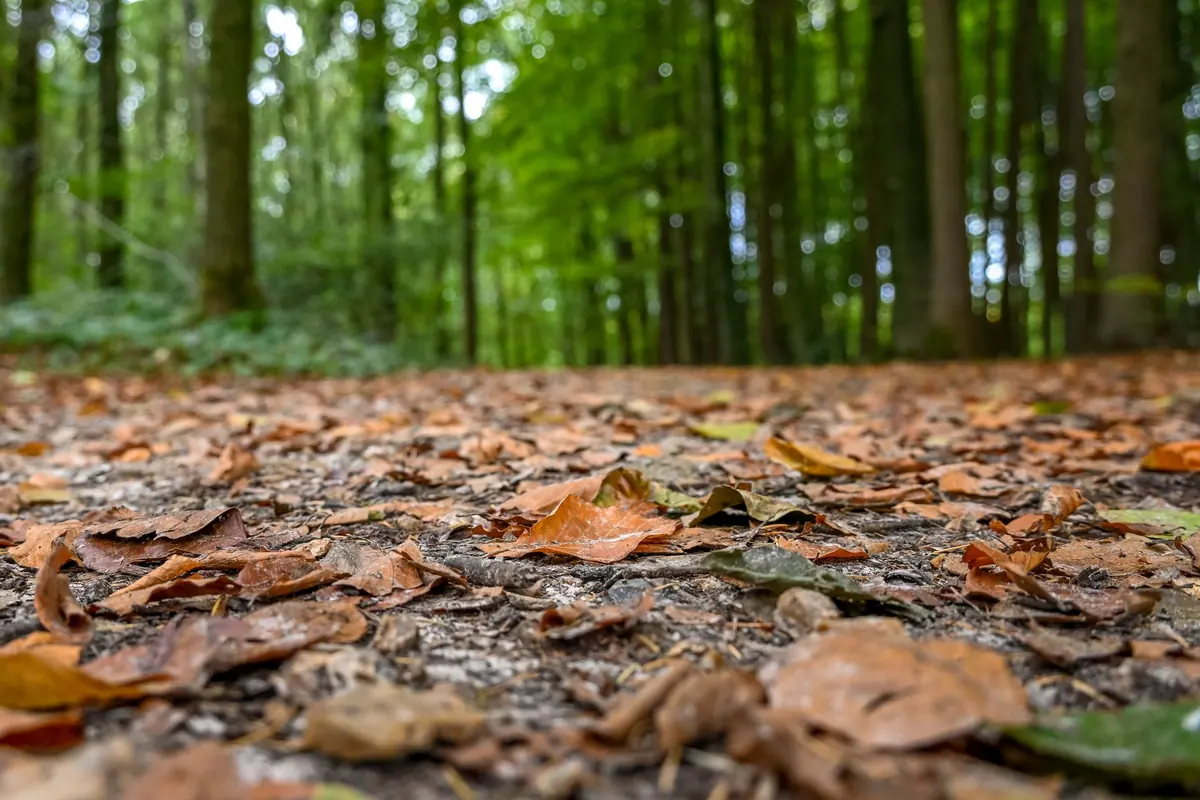
Autumn is the season that makes a place legible. The hedges thin, the field boundaries return, and a view you have looked at all summer suddenly shows its bones. If you write personal essays, that shift is useful: it gives you a ready-made frame for the two things the form does best — noticing where you are, and remembering what used to be there.
What follows are prompts, angles and research notes for autumn essays about landscape, loss and local change. Nothing here requires a remote island or a family scandal. A footpath, a bus stop, a school field and a gate that has finally been replaced will do.
Begin with the light, not the falling leaves
Everyone reaches for leaves. Reach for the light instead, or the sound underfoot, or the fact that at half past four the streetlights come on while the sky is still blue. Cliché in seasonal writing usually comes from generalising: “the leaves turned gold” tells us nothing. “The sycamore by the bus stop drops its leaves into the gutter, and every October the drain blocks and the corner floods to the kerb” tells us exactly where we are standing.
Give yourself an exercise with rules. Go out at the same time on three consecutive days. Record only what you can verify with your senses: the temperature, what you can hear above the traffic, who else is out, what has been left on the pavement. Resist conclusions. You are collecting material, not writing the essay yet.
One walk, returned to
Structure for this kind of essay is often a route. Pick a walk you do every year — to a grave, to a childhood street, along a river to a bridge, round a housing estate that used to be a field. Walk it deliberately and take notes at fixed points. On the page, those points become your sections, and the repetition becomes the argument.
The trick is contrast without announcement. You do not need to write “ten years ago, everything was different”. Put the two versions beside each other and let the reader do the arithmetic. The kissing gate has gone. There is a laminated sign about a missing dog, and someone has written over it in marker. The bench has been moved four feet so a delivery van could get past.
Writing loss through landscape
Loss is the reason many of us write essays, and it is also where the writing goes soft. The usual failure is naming the feeling too early. If you write “I felt a profound sadness”, the reader has nothing to do. If you write about your father’s bicycle still hanging in the garage, tyres flat, at a height you cannot reach, the reader does everything.
- Let objects carry the emotion. Coats, tools, keys, a particular mug.
- Trust your reader to infer. Cut the sentence that explains what the image means.
- Keep the weather and the admin of the day. Grief happens alongside parking charges and phone calls.
- Write the first draft for yourself, then edit for a stranger. The second version is usually shorter and better.
If a piece touches on your own mental health, or on someone who may read it, think carefully before publishing, and talk to someone you trust. A GP or counsellor is a better sounding board than a comment section.
Researching local change: where to look
You do not need to be a historian to ground an essay in fact. A few hours in the right places will give you dates, names and small revelations that make the writing specific. Work in this order:
- Maps first. Compare Ordnance Survey maps of the same area at different dates and scales. Look for what vanishes: a siding, a pond, an orchard, a footpath that now stops at a fence.
- The paper trail. County record offices and local studies libraries hold tithe maps, enclosure awards, estate plans and trade directories. Council planning portals and parish council minutes are online, and they tell you what changed last year, and why.
- Newspapers. The British Newspaper Archive and local titles on microfilm are good for accidents, demolitions, objections and the ordinary arguments that shape a place.
- Photographs and voices. Aerial photograph collections and photo archives can help you date a hedge or a shed. But the fastest route is usually a person: ask the neighbour who has lived there longest what used to be where the car park is.
Keep a research log as you go: source, date, one line on what it told you. When you come to write, you will want three or four facts, not thirty.
Ten prompts for an autumn essay
- A walk you take every year, described at the same four points.
- A building that has changed use three times in your lifetime.
- The last person in your family who worked outdoors.
- A lost footpath, and the sign that still points to it.
- Something you can see in October that is invisible in June.
- A shop or post office that closed, and what stands there now.
- A field you remember as a field, now something else.
- The sound of a place at dusk, listed without adverbs.
- A photograph of your street that you cannot date.
- An object you have kept from a place that no longer exists.
Shaping the draft
Two or three strands is enough: place, memory, and one fact you found in an archive. Alternate between them, and keep the present-tense walk as the spine so the reader always knows where they are standing. Short paragraphs help. So does a title that names something concrete rather than a mood.
Read the draft aloud. Where your voice speeds up, you are probably explaining. Where it slows down, you are probably close to the good material.
Start this week
Choose one prompt, one route, one afternoon. Walk it with a notebook and write down twenty details without judging them. Spend an hour with a map or a directory and find one date you did not know. Then draft eight hundred words in a single sitting, badly. The editing is where the essay arrives — and autumn, conveniently, gives you six weeks of changing light in which to do it.
Photo: Lorna Pauli / Pexels